Breathe confidently.
Flying with a portable oxygen concentrator is possible on many domestic and international flights—but approval, batteries and documentation must be arranged before you travel.

Airline information checked on . Always reconfirm the requirements before departure.
Can you take a portable oxygen concentrator on a plane?
Yes. Many airlines allow passengers to carry and use an approved portable oxygen concentrator, commonly called a POC, during a flight. However, an FAA-compliant machine does not automatically guarantee acceptance.
Airlines may require advance notice, a medical form, a doctor’s letter, the machine’s model information and enough charged batteries for the full journey.
Portable concentrator
Generates oxygen-enriched air from the surrounding environment and can operate from approved rechargeable batteries.
Oxygen cylinder
Stores compressed oxygen and is therefore subject to different and often much stricter aircraft safety requirements.
Important: Never arrive at the airport with an oxygen cylinder or concentrator without confirming the exact requirements directly with the operating airline.

South African airline requirements
The following summary is based on published airline information available in September 2026. Final acceptance can depend on the route, aircraft, medical circumstances and exact concentrator model.
| Airline | Notice period | Main requirements |
|---|---|---|
| FlySafair | At least 48 hours | Prior written approval, special-needs form, aviation-approved concentrator and independent battery power. |
| South African Airways | At least 48 hours | Approved battery-powered POC, medical clearance when required and sufficient approved batteries. |
| Airlink | Confirm at least 72 hours before departure | Special-assistance request and a POC carrying the required permanent aviation-compliance label. |
FlySafair
Written approval requiredFlySafair permits certain aviation-approved portable oxygen concentrators, but passengers must complete the approval process before travelling.
- Complete arrangements at least 48 hours before departure.
- Obtain prior written approval from FlySafair.
- Carry the approval letter and completed special-needs form.
- The concentrator must be aviation approved.
- Do not rely on an external aircraft electrical supply.
- Personal oxygen cylinders may not be used onboard.
FlySafair’s published list may not always show newer machines under their latest product names. Confirm your exact brand, model number and battery configuration directly with the airline.
View FlySafair’s official oxygen policy →South African Airways
Medical and battery requirements applySAA allows approved passenger-supplied portable oxygen concentrators on domestic and international flights, subject to its medical and operational requirements.
- Inform SAA when booking or at least 48 hours before departure.
- A Medical Information Form may be required.
- Passengers must provide their own approved battery-powered POC.
- Carry battery capacity equal to at least 150% of the flight time.
- Spare batteries must be carried in hand luggage.
- Battery terminals must be protected against short circuits.
- SAA permits one installed battery and up to two spare batteries, each not exceeding 160 Wh.
- Do not rely on aircraft power to operate or recharge the device.
SAA recommends arriving at least two hours before a domestic flight and four hours before an international flight when special assistance is required.
View SAA’s official special-assistance guidance →Airlink
Confirm assistance at least 72 hours before departureAirlink permits one portable oxygen concentrator carrying the required permanent label confirming that the device meets applicable aviation acceptance requirements.
- Submit a special medical-needs request.
- Provide the concentrator manufacturer and model.
- Provide the machine’s battery and power information.
- State whether the concentrator will be used during the flight.
- Provide any requested medical information.
- Receive confirmation before arriving at the airport.
Flying with LIFT, CemAir or an international airline? Contact its special-assistance department and obtain approval from every operating carrier, including airlines handling connecting flights.
What does FAA-compliant mean?
Travel-ready portable concentrators generally carry a permanent manufacturer’s label confirming that the device meets the applicable FAA acceptance criteria for carriage and use aboard an aircraft.
Airline staff may inspect this label at check-in or before boarding. However, the label does not replace the airline’s approval process. The airline can still request medical documentation, additional batteries or specific onboard arrangements.
Compliance label
Confirm that the label is permanently attached and clearly visible on the machine.
Airline approval
Obtain confirmation for your specific device, route and battery configuration before departure.

How many batteries should you carry?
A commonly applied requirement is enough battery capacity to operate the concentrator for at least 150% of the scheduled flight duration. SAA expressly includes this requirement in its published guidance.
The calculation above may not include check-in, boarding, taxiing, connecting flights or unexpected delays. A safer plan considers the entire door-to-door journey.
Battery runtime must also be calculated at the oxygen setting you have been prescribed. Runtime normally decreases as the machine’s setting increases.
Arrange additional approved batteries instead and confirm the permitted battery quantity and watt-hour rating with the airline.
Packing spare lithium batteries
- Keep spare batteries in cabin baggage, not checked luggage.
- Use the original packaging or an individual protective pouch.
- Cover exposed terminals to prevent a short circuit.
- Keep batteries away from keys, coins and other metal objects.
- Check the watt-hour rating printed on each battery.
- Request airline approval when a battery exceeds 100 Wh.
Documents to carry in your hand luggage
Airline documents
- Approval letter or confirmation email
- Special-assistance form
- Medical clearance form when required
- Approvals for connecting and return flights
Medical and product documents
- Doctor’s letter or oxygen prescription
- Concentrator user manual
- FAA-compliance information
- Battery watt-hour specifications
Ask the airline exactly what information must appear in the doctor’s letter before requesting it from your healthcare professional.
Pulse dose vs continuous flow during a flight
Many lightweight travel concentrators use pulse-dose delivery. The machine detects inhalation and releases a measured pulse of oxygen instead of supplying a constant stream.
A pulse setting is not equivalent to litres per minute of continuous flow. For example, pulse setting 2 should not automatically be treated as continuous oxygen at 2 litres per minute.
- Confirm that pulse-dose delivery is suitable for you.
- Discuss altitude and your prescribed settings with your doctor.
- Confirm that the device reliably detects your inhalation.
- Never change your prescribed setting without medical guidance.
- If continuous flow is required, confirm that both the machine and airline can accommodate it.
Your portable oxygen pre-flight checklist
One to two weeks before
- Discuss fitness to fly with your doctor
- Confirm prescribed oxygen settings
- Contact every operating airline
- Complete medical forms
- Request written approval
- Arrange enough batteries
The day before
- Fully charge every battery
- Test the machine on battery power
- Inspect the cannula and tubing
- Pack batteries separately
- Print or download approvals
- Keep medication in hand luggage
At the airport
- Arrive earlier than normal
- Notify the check-in agent
- Present your approval documents
- Keep batteries in cabin baggage
- Inform the cabin crew
- Follow storage and usage instructions

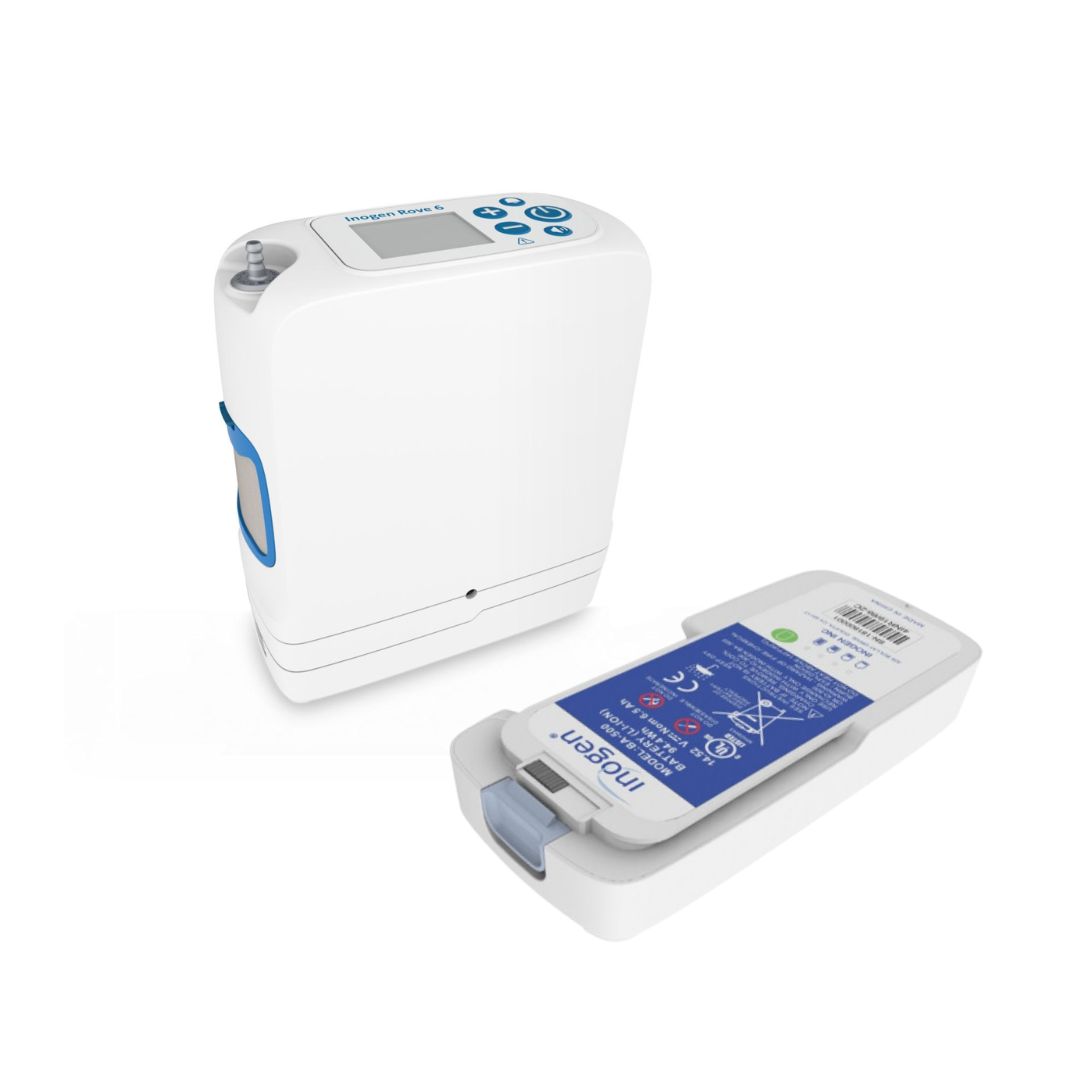
Meet the Inogen Rove 6
The Inogen Rove 6 meets FAA acceptance criteria for carriage and use aboard aircraft. Its lightweight design, six pulse-dose settings and extended battery option make it a premium choice for active oxygen users.
*Maximum stated runtime at setting 1 under specified operating conditions. Actual runtime varies.
Flying with portable oxygen: questions answered
Can I use my portable concentrator for the entire flight?
It depends on the airline. Some airlines permit approved POCs throughout the journey, while others may restrict use during taxiing, take-off or landing. Obtain written instructions before travelling.
Can I take a medical oxygen cylinder on a plane?
Compressed oxygen cylinders are commonly restricted or prohibited. FlySafair does not permit passengers to use their own oxygen cylinders onboard. Always confirm the policy with the operating airline.
Does FAA compliance guarantee airline approval?
No. It confirms that the machine meets specified acceptance criteria, but airlines may still require advance notice, documentation, battery information and written approval.
Can I charge my concentrator during the flight?
Do not rely on onboard power. Carry sufficient approved and fully charged batteries for the journey, including a sensible allowance for delays.
Do I need a doctor’s letter?
Many airlines require or may request medical documentation. The exact requirement depends on your health, whether the machine will be used onboard and the airline’s individual policy.
Can the concentrator go into checked luggage?
A concentrator required during travel should remain accessible in the cabin. Spare lithium batteries must be carried in hand luggage and protected against short circuits. Confirm the final baggage requirements with your airline.
Can I travel internationally with a portable concentrator?
Yes, if the machine is accepted by every airline operating the journey and all medical, battery and documentation requirements are satisfied. Obtain approval for connecting and return flights as well.
Need help choosing a travel-ready machine?
OxyMed supplies lightweight, battery-powered portable oxygen concentrators across South Africa. Our team can help you compare oxygen delivery, battery runtime, machine weight, charging options and travel accessories.